I. Development Status: From Concept to Core Industry Upgrade
The development of natural additives in cosmetics has evolved from the early stage of single plant extraction to a technology-driven diversified industrial system. The global market is undergoing a transformative shift from "efficacy priority" to "safety-natural-environmental protection," a trend that has become particularly prominent since 2020, with its annual growth rate (12%) far outpacing that of traditional cosmetics (6%).
The core drivers behind this development include three aspects: first, the upgrading of consumer demand—over 78% of consumers actively check ingredient lists, and 62% are willing to pay a 15%-30% premium for natural ingredients; second, breakthroughs in technological innovation—AI-enabled R&D, supercritical extraction, and other technologies have addressed the pain points of low efficiency and poor stability in traditional extraction; third, policy and regulatory promotion—the EU requires raw materials to provide sustainable traceability reports after 2025, and China has also listed the development of natural plant resources as a key priority. In terms of regional structure, North America and Europe once dominated the market (accounting for 35% and 28% of the market share respectively in 2025), while the Asia-Pacific region has emerged as the largest and fastest-growing market, with a share of 45% in 2025.
II. Application Status: Functional Segmentation and Scenario Diversification
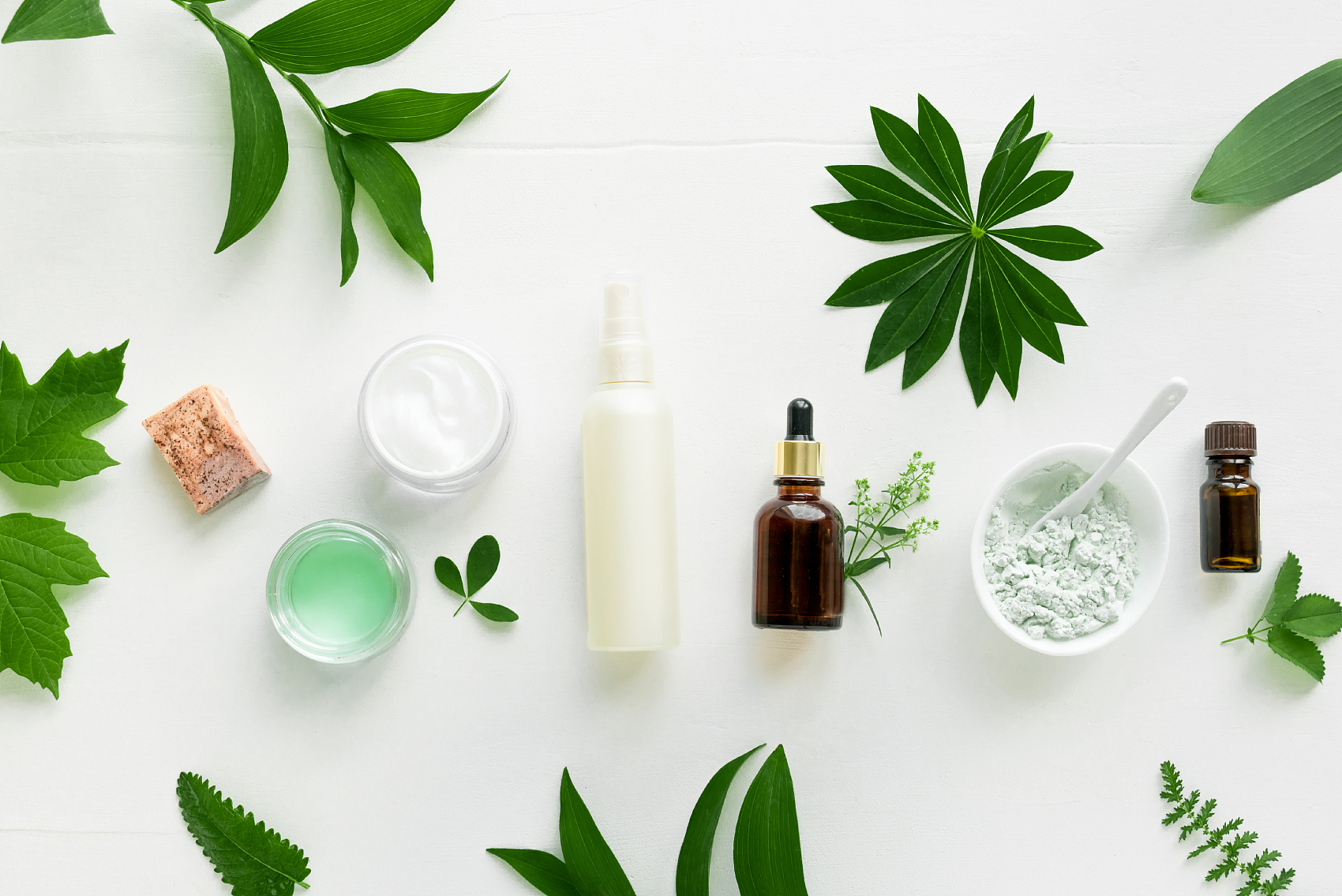
Natural additives have fully penetrated all categories of cosmetics, forming a clear application system divided by function and dosage form. By ingredient type, plant extracts occupy a dominant position, essential oils achieve the fastest growth, and mineral clays, natural vitamins, etc., have also formed stable application scenarios.
In terms of functional applications, distinct segmentation characteristics are presented:
- Anti-aging field: Rosemary extract is widely used for its antioxidant properties, and photolyase extracted through genetic recombination technology can repair DNA damage and reverse photoaging;
- Whitening and repairing: Green tea extract, bisabolol, and other ingredients have become core components, and some new ingredients screened by AI have significantly higher tyrosinase inhibitory activity than traditional raw materials;
- Soothing and moisturizing: Lavender essential oil, asiaticoside, etc., are used in sensitive skin products, and oat herb powder is frequently added to facial masks;
- Multi-scenario extension: Expanding from basic skincare to fragrance and bath products, for example, sea buckthorn extract has been developed into oil-soluble and water-soluble forms through differentiated processes to adapt to different dosage form requirements.
By product type, skincare products are the largest application scenario, accounting for over 50%, followed by hair care, color cosmetics, and body care products. The application concentration of natural additives in high-end product lines is generally higher than that in mass-market lines.
III. Usage Volume: Global Scale and Segmented Category Growth
The global usage volume and market size of natural additives in cosmetics show a synchronous high-speed growth trend. According to market research data, the global market size was USD 5.543 billion in 2024, increasing to USD 6.071 billion in 2025, and is expected to exceed USD 15.09 billion by 2035, with a compound annual growth rate (CAGR) of 9.53% from 2025 to 2035. By raw material type:
- Plant extracts: The market size was USD 3.2 billion in 2025, expected to reach USD 4.5 billion by 2030;
- Essential oils: The market size was USD 1.8 billion in 2025, expected to exceed USD 2.5 billion by 2030;
- Herbal powders: The market size was USD 2.2 billion in 2025, approaching USD 3 billion by 2030.
The regional distribution of usage volume is highly consistent with the market size. As the largest market, North America accounted for 35% of the global natural additive usage in 2025, Europe 28%, and the Asia-Pacific region 45%. Among them, the penetration rate of natural ingredient products in the Chinese market jumped from 23% in 2018 to 41% in 2023, and is expected to exceed 60% by 2026. In terms of efficacy demand, anti-aging and whitening products have the highest usage of natural additives, with the addition of plant extracts in a single essence product reaching 5%-15%, far higher than the 1%-3% in basic moisturizing products.
IV. In-depth Analysis of Regional Markets
1. Europe: A Benchmark for Policy-Driven High-Endization and Compliance
Europe is the "rule-maker" and core high-end market for the natural additive industry. Regulation (EU) 2025/877 issued in May 2025 further tightens raw material control, adding 21 new ingredients to the list of prohibited chemical substances and clarifying usage restrictions on ingredients such as trimethylbenzoyl diphenylphosphine. This policy directly drove an 18% growth in demand for natural alternative raw materials. The market is characterized by "double high" attributes: high-end lines account for over 60%, and organic certified raw materials command a 40% premium. In terms of applications, Mediterranean plant extracts (such as olive leaf and rosemary) account for 30% of the market share due to local traceability advantages, with an addition concentration of 12%-20% in anti-aging essences. In terms of regional structure, France and Germany contribute 70% of the market share—the former focuses on the application of fragrance essential oils, while the latter leads the world in natural preservative technology.
2. North America: Technological Leadership and Supply Chain Restructuring in Parallel
The North American market is characterized by technological innovation and strict regulation. The market size of plant extracts reached USD 2.192 billion in 2025, accounting for 37.1% of the global share, and is expected to increase to USD 5.5 billion by 2035, with a CAGR of 9.63%. At the policy level, the US FDA's 2025 regulatory agenda prioritizes New Dietary Ingredient Notifications (NDIN) and natural colors, requiring manufacturers to submit safety evidence 75 days in advance. Canada will also implement the new edition of the "Good Manufacturing Practices Guidelines for Natural Health Products" in 2026. At the technological end, AI-driven green extraction technology has been rapidly popularized, with the usage rate of ultrasonic extraction equipment increasing by 50% compared with 2023, and nanoemulsification technology improving the bioavailability of ashwagandha extract by 2.1 times. The supply chain is significantly affected by tariff policies—the US imposes a 10%-50% tariff on raw materials from Asia, prompting enterprises to establish processing bases in Mexico, and the share of nearshoring production capacity is expected to reach 35% by 2027. At the consumer end, functional fungi (such as lion's mane mushroom) have experienced explosive demand due to "cognitive health" needs, with a CAGR of 23.4% from 2024 to 2029.
3. Southeast Asia: Demographic Dividend and Explosion of Localized Demand
The Southeast Asian market has achieved rapid expansion relying on economic growth and demographic dividends. The Indonesian beauty market size reached USD 8.5 billion in 2024, with a growth rate of 6.2%, among which the demand for natural ingredient products increased by 12% annually. Regional demand presents distinct localized characteristics: Indonesian consumers prefer waterproof sunscreen products (SPF50+) made from coconut oil, local turmeric, and other raw materials; 62% of Gen Z in Vietnam are willing to pay full price for effective plant ingredients; 47% of demand in the Thai market is concentrated on skin-brightening natural ingredients. The channel structure is accelerating onlineization, with social e-commerce contributing 25% of beauty sales, directly driving a 30% annual growth in sales of cost-effective natural masks (priced at USD 10-30). In terms of raw material applications, repairing ingredients such as ceramides and linseed oil have seen a 45% growth in demand in 2024 due to adapting to barrier problems caused by the tropical climate. Although the awareness of probiotic natural additives has risen from 18% to 52%, the product supply gap still reaches 60%.
4. India: Local Resource Advantages and Mass Market Dominance
The Indian market presents a "dual-driver" characteristic of raw material export and local consumption. As the world's largest producer of ashwagandha, it supplies 80% of the North American market, but price fluctuations exceeded 15% in 2025 due to climate variability. At the local consumer end, the market size of natural cosmetics exceeded USD 2 billion in 2024, with a growth rate of 15%, among which herbal powders account for 40% of raw materials. Neem and sea buckthorn extracts are popular due to high recognition of their traditional medicinal properties. The market is dominated by mass-market lines (priced below USD 10), accounting for over 75%, and the penetration rate of e-commerce channels has risen from 28% in 2022 to 42% in 2024. At the policy level, the Indian government has launched the "Local Raw Material Revitalization Plan," providing a 20% subsidy to organic planting bases, and the self-sufficiency rate of local raw materials is expected to increase from the current 55% to 70% by 2028.

V. Future Outlook: Triple Breakthroughs in Technology, Sustainability, and Standards
The future of the natural additives in cosmetics industry will evolve around three core pillars: technological innovation, sustainable development, and standardization, presenting the following trends:
1. Technology-Driven Precision Development
AI technology will fully penetrate the entire R&D process. By simulating the mechanism of ingredient action through algorithmic models, the raw material screening cycle can be shortened by more than 50%, while realizing "personalized ingredient customization." Extraction and stabilization technologies will continue to upgrade—supercritical extraction, molecular vectorization penetration, and other technologies will increase the retention rate of active ingredients to over 90%, and microencapsulation technology can extend the stability period of ingredients to 24 months. Interdisciplinary integration will accelerate, and natural active substances explored from new fields such as mitochondrial skincare and skin longevity science will become the core raw materials of the next generation.
2. In-depth Construction of Sustainable Systems
The concept of "circular economy" will run through the industrial chain. At the raw material end, the "upcycling" model of waste resources such as sea buckthorn leaves will be promoted, and organic planting demonstration bases will be established to achieve raw material traceability; at the production end, the construction of carbon-neutral factories will be promoted to reduce energy consumption in the extraction process; at the packaging end, 100% recyclable or biodegradable materials will be used. ESG performance will become the core competitiveness of enterprises, and the carbon emission intensity of the raw material supply chain is expected to decrease by 30% by 2030.
3. International Unification of Standards and Specifications
To address issues such as vague definitions of "natural" and "greenwashing," the global community will accelerate the construction of a unified evaluation system covering raw material naturalness testing, sustainability traceability, efficacy verification, and other full dimensions. Institutions such as the International Cooperation on Cosmetic Regulation (ICCR) will promote mutual recognition of standards, and China is expected to participate in formulating 3-5 internationally leading evaluation standards for natural ingredients. At the same time, the efficacy evaluation technology system will be more improved, and triple verification through cell, animal, and human tests will become a necessary condition for ingredient listing.
4. Reconstruction and Upgrade of Market Structure
The Asia-Pacific region will establish its position as the world's largest market by 2030, with a share exceeding 40%, among which China will become the core hub for the R&D and application of natural additives. At the consumer end, the shift from "pursuing natural concepts" to "focusing on substantial efficacy" will drive the industry to transform from "trace addition" to "high-efficiency compounding," and natural ingredients with clear targets will dominate the market.
VI. Conclusion: Global Synergy and Value Reconstruction of Natural Additives
The natural additives in cosmetics industry is standing at a historical juncture of "technological innovation, regional synergy, and value upgrading." Europe sets the industry benchmark with policy compliance, North America breaks through efficiency bottlenecks with technological innovation, Southeast Asia releases incremental potential relying on demographic dividends, and India consolidates the supply foundation with resource advantages, forming a multi-level global market pattern of "high-end leadership, mid-market explosion, and basic supply."
In the next decade, industrial competition will evolve from a single ingredient competition to a systematic capability contest of "technological R&D - sustainable supply chain - standardized verification." With the popularization of AI R&D, the implementation of circular economy, and the unification of international standards, natural additives will completely shake off the label of "conceptualization" and become the core engine of cosmetic efficacy innovation. The complementary integration of differentiated regional market demands and technological advantages will promote the global industry to achieve a qualitative change from "scale growth" to "value enhancement," ultimately building a safe, efficient, and sustainable new ecosystem of cosmetic raw materials.